
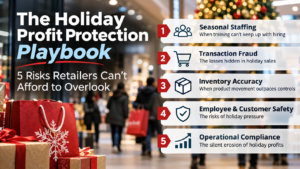
Why protecting holiday profits takes more than stopping theft.
Every holiday season, sales climb, stores fill up, and leadership is rightly focused on the top line. Then the year-end numbers come in, and margin hasn’t kept pace with revenue the way everyone expected.
Shoplifting and organized retail crime get most of the attention this time of year, and some of that attention is earned. But IHL Group and Sensormatic Solutions’ Beyond Shrink: 2026 Global Total Retail Loss Study puts external theft at 25% of retail loss. The other 75% comes from the supply chain, returns, e-commerce fulfillment, and administrative errors: parts of the business that never show up on a security camera.
One finding from that study stuck with me. Administrative process errors cost retailers an average of $103.40 per incident, nearly the same as the $107 average cost of an employee theft incident. One of those gets an investigation. The other usually gets written off as shrink.
Here are the five areas I’d look at before the holiday rush peaks.
1. Seasonal staff are trained to sell, not to spot problems
Holiday hires usually get a compressed onboarding built around the register and the customer. Fraud awareness, cash handling, escalation procedures, and safety get a slide or two, if that. That gap is where both honest mistakes and deliberate misconduct start.
A seasonal associate doesn’t need the full loss prevention curriculum. They do need to know what a suspicious return looks like, who to call when something feels off, and what not to do when they see a theft in progress.
2. Record sales can hide transaction losses
Volume is cover. When a store is ringing twice its normal transaction count, a pattern of improper discounts, price overrides, or refunds to the same card can sit in the data for weeks before anyone notices. Refunds, gift cards, employee purchases, and loyalty transactions all deserve a closer look in December.
Exception-based reporting, backed by video verification where it makes sense, is the most practical way to catch this. The key is looking at patterns by employee and by store over time, not reviewing one transaction at a time.
3. Inventory discrepancies get booked as shrink instead of traced to the source
Product moves faster in the fourth quarter than at any other time of year, through distribution centers, receiving docks, store transfers, and online fulfillment. Every handoff is a chance for a count to go wrong, and most of those errors end up in the shrink number with no further explanation.
Here’s an example. One of our national clients had a 0.04% variance allowance built into its third-party delivery agreement. When we audited those deliveries nationwide, we found the actual variance in the first quarter was over 3.5%, nearly 90 times what the contract allowed. That loss wasn’t coming from a shelf on the sales floor. It was coming in through the back door, one delivery at a time, and without an independent audit it would have kept getting absorbed into shrink.
For retailers with many locations, small inconsistencies in how receiving and inventory controls are carried out add up fast. Independent audits at the store level are how you see the gap between the written procedure and what actually happens.
4. Holiday pressure raises the safety risk
Crowded stores, longer hours, tired employees, and frustrated customers are a combination that raises the risk of aggressive behavior, theft-related confrontations, and workplace violence. Seasonal associates, who have the least experience handling these situations, are often the most exposed.
This is the time to reinforce de-escalation training, emergency response procedures, and incident reporting, and to make the policy on engaging shoplifters completely clear. A confrontation that injures an employee costs far more than anything that walked out the door.
5. Store procedures slip exactly when they matter most
This is the one I see most consistently. When we conduct audits for our retail partners during the holiday season, we usually see a significant drop in overall company performance, with audit scores lower than at other times of the year.
It isn’t that managers are ignoring the rules. They’re staffing, replenishing, and chasing a sales number, and routine controls slide down the list: cash handling, opening and closing procedures, inventory verification, safety walks.
None of that makes headlines. But go back to the $103 vs. $107 comparison. Process errors cost almost as much per incident as employee theft, and in December there are more of them. A peak-season audit program is how you find out what’s actually happening in your stores, rather than what the procedure manual says should be happening.
Looking past theft
Theft is real, and it’s rising. But treating loss as only a theft problem means missing most of it. Protecting holiday margin takes Asset Protection, Operations, HR, Finance, and Supply Chain working from the same picture.
That’s the work we do at The Integritus Group: outsourced and co-sourced loss prevention, independent operational audits, investigations, transaction analysis, and training. It gives retailers more visibility without adding headcount.
One question worth asking before the rush peaks: is your holiday plan built to stop theft, or to protect margin? They aren’t always the same plan.
The Integritus Group | Profit Protection. Operational Integrity. Total Retail Loss.